“Do I contradict myself? Very well then, I contradict myself. (I am large, I contain multitudes.)”
-Walt Whitman
“Parts Work” is, among other things, a coaching strategy. This term has its background in both therapy and NLP (neuro-linguistic programming). While it is used by some skilled coaches, it is also a very powerful and straightforward tool you can use for yourself.
Parts work is a simple and imaginative way to address conflicts within the self. We use our imagination to envision parts of ourselves as responsible for certain behaviors and recognize them as not the central self, but as entities within us with separate motivations and personalities.
We already are thinking this way much of the time. It is why we say things like, “I’m getting in my own way.” Or we describe internal conflict or decision-making by saying, “Part of me wants X, but part of my wants Y.”
Here is an example of parts work in action. My client sometimes yells at her children when she is mad. The way she deals with this (the way most people do) is by thinking “I am a bad person,” or “they don’t know what they are doing; why am I yelling at them?” or trying to ignore that it happens and hoping it won’t happen again.
Let’s see what happens if she takes a “parts work” approach. First, she would ask herself, “What is the part of me that is yelling?” She might name it “the angry part” for simplicity’s sake. Just this first step will put her in a position of observing the behavior so she can look at the motivation behind it, start to examine and be curious about it.
Then she might ask, with some level of self-compassion, “where else does the angry part of me show up in my life?” She sees that it shows up when she is feeling disrespected or powerless. Now she can see that there is a positive intention behind this part. It’s not just an “angry” part. It may be a part that is trying to stand up for her when she believes she is being disrespected or when she is feeling powerless. She may not like the way this part is taking a stand for her, but she can appreciate the fact that it is.
In this way, she might start to develop a relationship with the part. She might say, “thanks for trying to stand up for me. I know you are feeling disrespected by the children and it’s your job to make sure that doesn’t happen. What would you need from me to not yell at them when you are feeling disrespected?”
If you have never encountered parts work, this may sound a bit strange. But the alternative – the way we usually operate – is to banish the parts we do not like. To be ashamed of yelling; to pretend it won’t happen again. This is Carl Jung’s “shadow,” and in parts terminology means we end up with a number of disowned parts: the part that yells, the part that is lazy, the part that is conflict-avoidant.
The problem is, as Debbie Ford says in a great book on this topic: “What you don’t own, owns you.” (The Dark Side of the Light Chasers) It is well known in the world of parts and shadows that when you try to push down a behavior (part) you don’t like, it ends up “driving the bus.”
For more information on this, I recommend the Debbie Ford book. The therapy equivalent (similar but more complex) is Internal Family Systems and a great book is No Bad Parts, by Richard Schwartz.
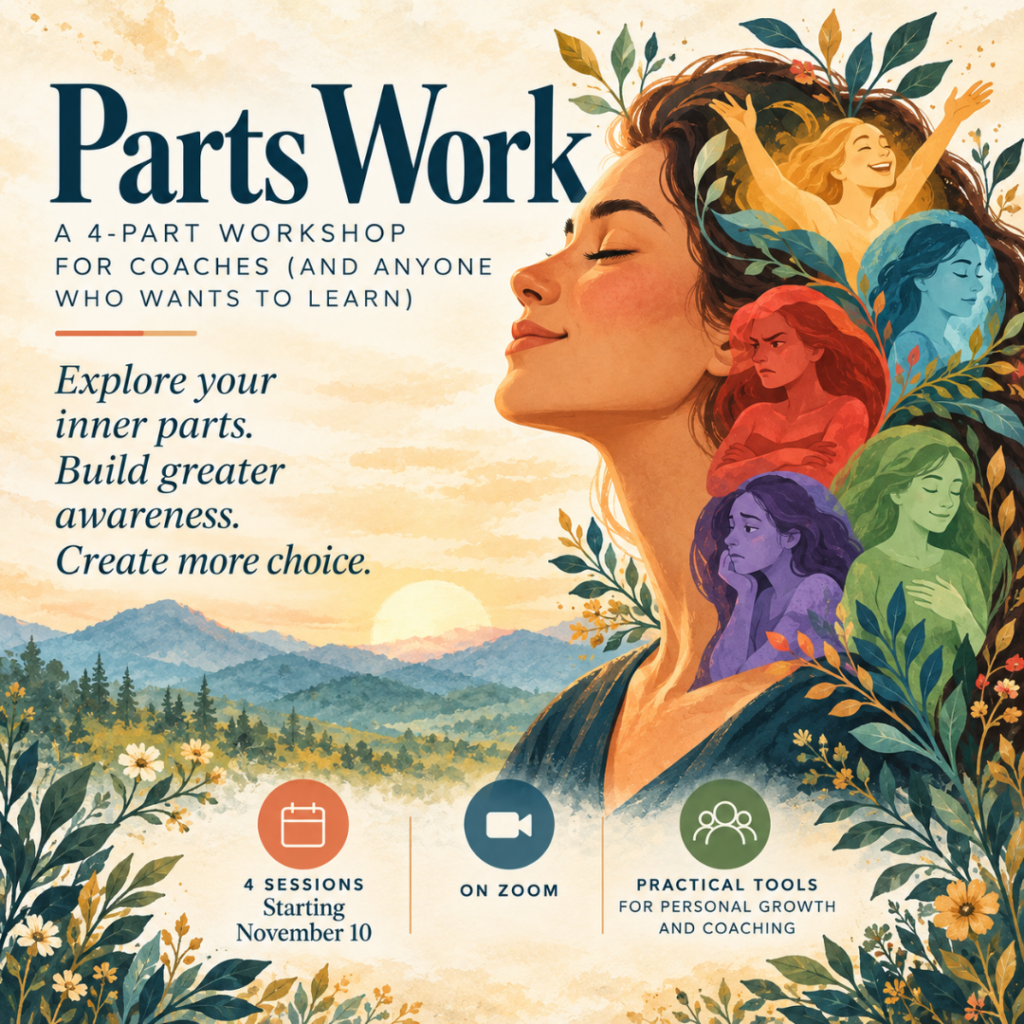
Finally, I am teaming up with Monique Tula (www.cadenceconsulting.community ) to bring a parts work workshop to coaches and anyone who wants to learn this amazing tool, in a 4-part series starting November 10. Email me to discuss or register!
The Workshop
This four-session training introduces participants to a practical, parts-based approach for working with internal conflict. Through demonstration, guided practice, reflection, and coaching exercises, participants will learn how to identify different parts, recognize opportunities to use parts work in themselves and in coaching conversations, and help themselves and clients build greater awareness, choice, and self-understanding.
This workshop is informed by parts-based frameworks, including NLP and Internal Family Systems (IFS), but is not an IFS certification or practitioner training. It is designed as a foundational training for coaches who want to expand their professional toolkit and integrate parts work into their existing practice.
Logistics:
Session One: Meeting the Voices Within (November 10, 11am – 12:30pm PT)
Session Two: Protective Parts at Work (November 17, 11am – 12:30pm PT)
Session Three: Who are the Other Parts? (December 1, 11am – 12:30pm PT)
Session Four: Integration: Facilitating Parts Conversations (December 15, 11am – 12:30pm PT)
Where: Zoom
Cost: Regular cost is $600 for all 4 classes, but we are offering a sliding scale down to $400 if you need it. $100 deposit to register and payment plans are available.
To Register: Cami@mclarencoaching.com