
One of the most common misconceptions about coaching is the idea that a coach is someone who has their life figured out.
People often say they can’t become a coach because:
- “I don’t even have my own life together. How could I tell other people how to live?”
- “I need to work through this first. Then I’ll be ready.”
- “I need to have answers for my own life before I can help anyone else.”
This way of thinking makes sense. In many fields, expertise is defined by certainty and mastery. We’re used to teachers, advisors, and helpers being the ones who know.
But coaching works differently.
Coaching is not about having answers, solutions, or modeling your life for someone else. It’s not about advice-giving, problem-solving, or fixing.
At its heart, coaching is a practice of attention—the ability to hold a meaningful space for exploration.
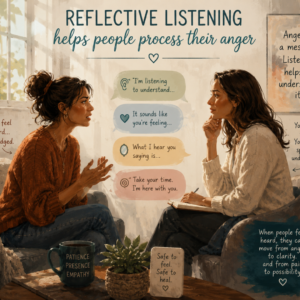
A coach listens deeply, not to diagnose or correct, but to understand how someone is making sense of their world. A coach asks questions that help a person hear themselves more clearly. The value of coaching comes not from the coach’s opinions or experiences, but from their capacity to stay present, curious and grounded while someone else explores their own worldview.
From this perspective, having your life “together” isn’t a requirement. (Also, who has their life together!?) The belief that you need to be fully resolved before you can be useful often confuses coaching with mentoring or advising. Many professions are based on the professional having specific knowledge and ability to advise.
In coaching, not knowing isn’t a problem—it’s a feature. It is how we ground ourselves in curiosity. We teach ourselves to not know. We teach ourselves not to try to “figure out” what the client may need. We unlearn the tendency to try to show people how to live.
This is why coaching can feel different from other helping relationships. Instead of being told what to do, people often feel more deeply heard. Instead of being directed, they’re invited into reflection. Over time, this strengthens trust in their own thinking and decision-making.
When coaching is done well, it doesn’t depend on the coach having a flawless life. It depends on their ability to be present with another person, to listen without agenda, and to trust that insight emerges through conversation.
If you’ve been waiting to get it together, please don’t. You’re perfect! Our next program starts on February 7! (www.mclarencoaching.com/coach-training)